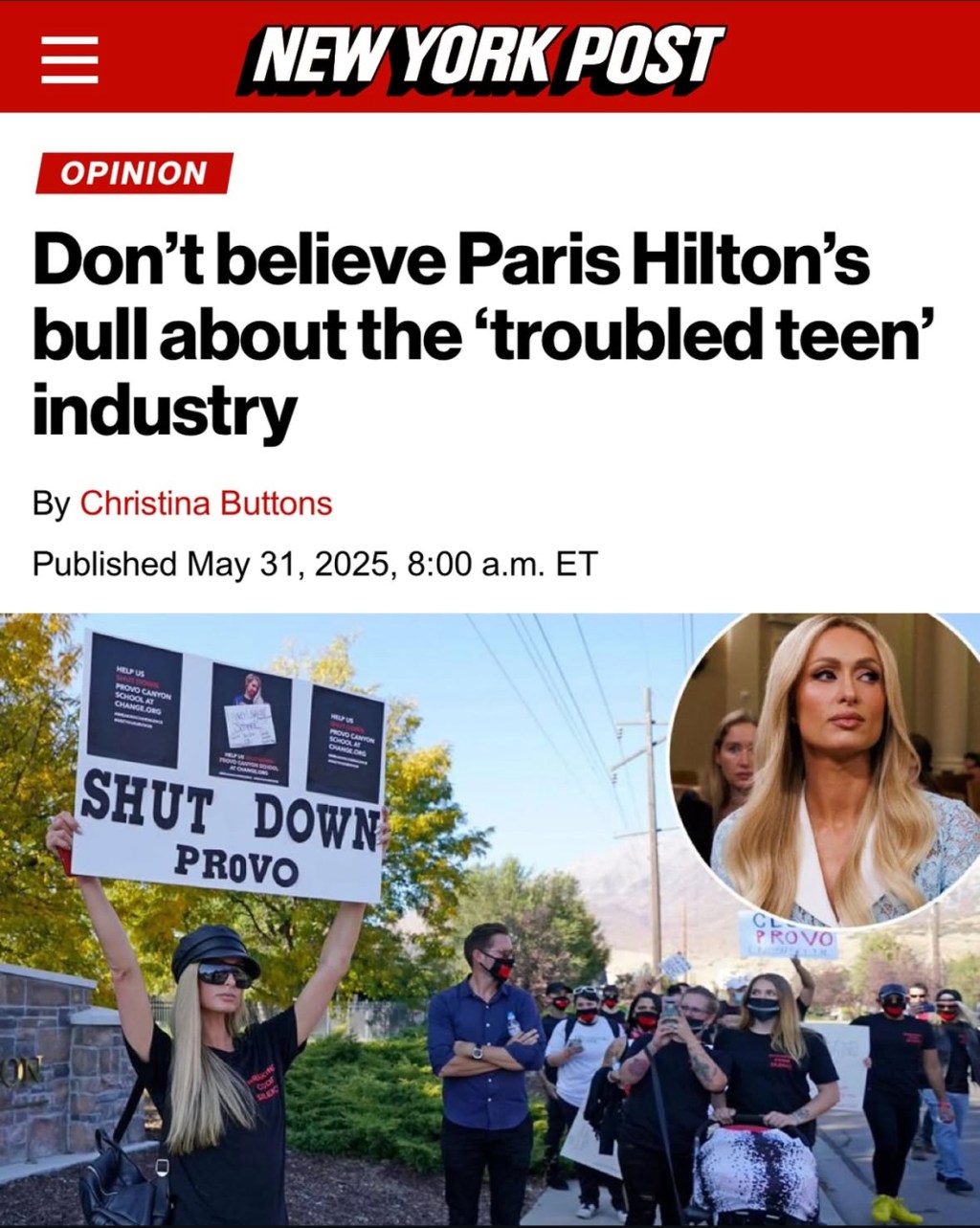
Shame on the NY Post: Survivors of the Troubled Teen Industry Deserve Truth
The recent opinion piece published in the New York Post—“Don’t Buy Paris Hilton’s Bull About the Troubled Teen Industry” by Christina Buttons, a former “troubled teen”—is not only dismissive and misleading, it is dangerously complicit in the ongoing silencing of abuse survivors from what has come to be known, rightly, as the troubled teen industry.
Let’s be clear: there is a difference between legitimate residential treatment centers and the troubled teen industry. The latter refers to a network of loosely regulated programs—boot camps, wilderness programs, conversion “therapies,” and lockdown facilities—that for decades have profited off the pain of vulnerable youth, often under the guise of treatment. Survivors have consistently described these programs as places of emotional, physical, and sometimes sexual abuse, often paired with sleep deprivation, forced isolation, and denial of medical care.
What Paris Hilton and countless other survivors, myself included, have called for is not a blanket condemnation of all therapeutic care—but transparency, oversight, and regulation in an industry that has operated in the shadows for far too long.
The author of the NY Post piece, while a former Provo Canyon School attendee, uses her personal experience to dismiss a mountain of testimony from other students—including her own classmates. This isn’t just invalidation. It’s erasure. It sends a dangerous message: that unless you experienced the abuse yourself, others’ trauma must be exaggerated or false.
That mindset protects abusers. It emboldens institutions that traffic in coercion and secrecy. And it flies in the face of the deeply American principle that whistleblowers—especially survivors—deserve to be heard, not humiliated.
This is not about Paris Hilton’s celebrity. It’s about the hundreds of thousands of youth, disproportionately disabled, neurodivergent, LGBTQ+, and children of color, who have been funneled through these programs—often against their will, often with long-lasting psychological consequences.
Survivors are not “selling a sob story.” They are exposing a multi-billion dollar industry that thrives on parental desperation and systemic neglect. The NY Post’s choice to platform such a dismissive take, without balancing it with the voices of actual survivors, is not just irresponsible—it is part of the problem.
If we are to break cycles of abuse, we must first believe those brave enough to speak. Even when it’s uncomfortable. Even when it challenges institutions we once trusted.
Paris Hilton’s advocacy—alongside organizations like Unsilenced and the introduction of legislation like the Stop Institutional Child Abuse Act—isn’t “bull.” It’s one of the most significant survivor-led efforts to protect our nation’s youth from sanctioned harm.
We don’t need fewer people speaking out. We need more. And we need to listen.
Shame on the New York Post and the Manhattan Institute for amplifying this kind of sensationalist disinformation. To allow someone who calls themselves an investigative reporter to publish a piece without doing even the most basic due diligence—without engaging the mountain of survivor testimonies, government investigations, or decades of data on the harms of the troubled teen industry—is not journalism. It’s complicity. It’s a slap in the face to every survivor who has risked their safety, reputation, and mental health to speak out.
Survivors deserve more than clickbait. They deserve justice.
If this resonated with you—please like, share, and help amplify survivor voices.
Every share chips away at the silence that has protected these institutions for too long.
If you’d like to read more, my full survivor testimony is available for free as a chapter excerpt from my memoir.
Together, we can build a world where youth are protected, not punished.
 Jessica Woodville | Memoir & Musings
Leave a comment